English Muffin Sandwiches

I woke up today in a creative mood, so I threw together some homemade McMuffins. The result was awesome, so I’m posting my process in lieu of sharing my actual food. Which was awesome.

I did manage to postpone consumption long enough to take an illustrative photo of them:

The bread (Thomas Original, on sale last week) went in the toaster oven for 8 minutes whole. All week I’ve been opening the muffins before toasting and have been unhappy with the results. This worked much better, with a firm crusty exterior and a soft, fluffy interior replete with nooks and crannies. Sorry, but it’s actually illegal to discuss English muffins without using the phrase “nooks and crannies” somewhere.

The N&Cs needed something to contain, so I cracked a jumbo egg into each of two Pyrex 10 oz custard cups. These happen to be the ideal size for preparing eggs for an English muffin; I use cereal bowls if I’m making bagel sandwiches. The eggs got salted (table, not kosher) and peppered (mixed blend, fresh ground) and went into the microwave, which I think is underrated as a means of egg cookery. With vigilance some excellent results can come from a little radar love.

The eggs got nuked on ‘high’ for 20 seconds at a time, pausing each interval to sweep a fork around their edges. This serves two purposes: first, it keeps the eggs from sticking too badly to the dishes, and second, it releases any stored-up heat from underneath the egg which will, if left alone to build up, escape violently later and blow egg all over the microwave. Several of these intervals are required, but patience will be rewarded.

When the eggs were nearly done, I sliced up half of a small Virginia smoked sausage that I grilled last week and keep in the fridge for just such an emergency. These slices were Domino’s-pepperoni-thin, to promote very fast cooking, actually just reheating (within one 20-sec burst in the microwave).

The English muffins went ding, so out they came. I pierced all around the edges with a fork in order to perforate the muffins before pulling them open. This is essential. I’ve had muffins that were thick enough to pull open without piercing first, but these relatively flat little guys would have been destroyed by such rough handling. Slicing open an English muffin with a knife ruins it; the trademark internal texture is wasted and that convoluted surface area is reduced to a noninteractive sheer surface, happy to let sauces and toppings slide right back onto the plate.

The eggs, now a light over medium (yolks soft and slightly runny, whites solid but light and very fluffy) went onto the open muffins, topped as shown with a ring of sausage slices, and a small slice of butter went right on top of the yolk to melt and be received by the upper muffin once assembled.

Cheese is normally an unskippable step here, but all I had was Provolone and I was concerned that a big slice of cold cheese would ruin my temperature balance, as well form a smokefest when combined with the already smoky sausage, potentially masking all other flavors. If you have something more balanced available, I recommend using it, perhaps melting over the muffins before assembly.

The proof, of course, came in the eating, and I did miss the cheese a little for structural reasons – my sausage bits wanted to slip away once the butter melted around them, and I would have appreciated a binding agent. But the flavors were excellent, and I’m very pleased with the result.

I have eggs on the brain this week, so stay tuned. If my egg/sweet potato combination theory works out, I’ll let you know.

I survive on eggs and comments, so leave one or the other below if you don’t mind.

UNHOLY!

From time to time a news item will come to my attention, more often than not involving some sort of Asian technology research (or pop culture – I agree with the blogger who suggested that even the Japanese don’t get the Japanese anymore), and I quietly nod, push my chair back, and cover my head with my arms because I assume the world is about to be destroyed. I’d kind of like to make these items a regular feature, but I’m not sure what to do with the format. For this first one I’m going to ask Donald Sutherland to help me express my reaction:

Image is from 1978 Invasion Of The Body Snatchers, thanks Moondog.

But the subject at hand is: Things we’ve invented which will eventually kill us all. I’m not talking about boring things like high fructose corn syrup; I am just as angry as you when a nature show purports to list the 10 Somethingest Somethings and inevitably gives the number 1 spot to an insect or microbe instead of something cool like a dinosaur. No fakeouts here, just earnest warnings.

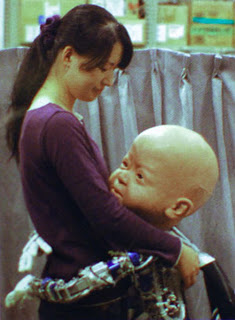
THREAT: Robot baby
Researchers at UCSD have developed a giant robot baby with an even more giant robot baby head capable of expressing realistic emotions and frightening everyone except the brainwashed drones who work in their lab. Click the photo for the story.

Have any horrible abominations of your own? Well for heaven’s sake don’t share them. I’ve got enough to cope with here. But I’ll welcome comments.

Ever Since I Was A Little Amazing

Harry Blackstone’s book, Tricks Anyone Can Do (1983), describes a trick called the “Surprising Cigarette.” The verbal explanation of a sleight-of-hand trick is always a little hard to follow, but here’s Blackstone’s version:

 When taking the cigarette from his mouth, the backs of the first and second fingers are placed against the lips, the thumb resting on the chin. The hand is then turned over so that the light really is toward the tips, but with his thumb, he pushes up on the cigarette giving it a second turn as the second finger moves away, which leaves the cigarette between the thumb and forefinger. The trick lies in the fact that two turns are made, not one as appears.

As a kid, I practiced and practiced this move, assuming that when I was an adult and therefore a smoker, it would be a slick move to pull to impress people. Take your pick whether it’s more awful that I thought all adults smoked and always would, or that it was imperative that I learn ways to impress people in order to make friends. The point is, this is a tough move to pull off without giving away the fact that something tricky is happening, even if you use 3/4 scale cigarettes to compensate for having child-sized hands, as I did. [Mom, if you’re reading this, I want  to assure you that I have never been a smoker despite my early misapprehensions.]

Not having worked on my technique for many years, imagine my surprise today when I attempted to insert a fully-charged battery into my digital camera and successfully performed The Surprising Cigarette not once, not twice, but three times on myself, without the audience (me) ever catching on how it was done! Three times I carefully noted the markings on the battery compartment and the corresponding notation on the battery label, lined them up, and then inserted the battery backward, its shiny gold terminals winking in the sunlight as if to mock me.

The trick did not stand up to a fourth, slower performance, but for a moment, as my audience (me) stared in amazement at what I had done, I felt magical.

Glorious Media Future

I remember when I first used a computer to connect to another computer with a modem. It was a 286 PC with a CGA monitor, I think I was about 11 (it was right before my Hogwarts letter arrived), and it was awesome. I assumed WarGames was a realistic image of what an enthusiastic kid could do with a computer, so I was eager to explore the world’s top-secret databases.

In actual fact, the computer we were connected to was running IDEAnet, the Indiana Department of Education Anteater network (I may not be completely accurate on the acronym). It wasn’t ARPAnet, but thanks to Ferris Bueller, it was still a Matthew Broderick-equivalent level of access. I couldn’t change my grades–they weren’t actually tracked on computer yet–but my mother could get whatever teacher-related stuff she needed from it, and I soon discovered I could look at salary figures for any public school employee. This was deeply humanizing information in my eyes, and I think I defended my teachers to my friends as real people a little more vehemently because of it. It wasn’t blackmail-worthy, because the underpaid teacher is a stock punchline. But it drove home the point that soon, EVERYTHING would be connected via modems and  there would be no limit to what you could learn if you were willing to scan enough phone numbers.

This was not the Internet. That came a few years later. We were active members of Prodigy, an online community which at the time was the sexy GUI alternative to CompuServe. What it did not offer was user-selectable IDs. For years, I gave people my email address (bnmx41b@prodigy.net, or possibly .com; well that’s going to keep me awake) and was indignant when they acted like it was hard to remember. AOL made this particularly bothersome, with their handles that you selected yourself and contained actual words. The fact that Prodigy introduced several of the core features that AOL used to become popular was outweighed by the fact that Prodigy never figured out how to turn innovation into actual success. On Prodigy, there was some click-to-turn-page graphic novel content, a sci-fi turn-based play-by-email game called Rebel Space, and bulletin boards where I first learned to communicate with people who only existed through text. Prodigy’s censorship and content control were remarkably ahead of their time; even Comcast has yet to suggest plans to ban users from referring to each other by their real names.

This was still not the Internet. When the Internet did arrive, it pretty much killed Prodigy. They experimented briefly with changing their membership plans from flat-rate to hourly usage, and never really stopped hemorrhaging memberships even when they switched back. When the Internet did appear, Prodigy provided WWW access through its own software, which sucked, but you couldn’t use another browser or communicate with a non-Internet Prodigy member. We left around this time, joining our first true ISP and embracing Netscape Navigator.

Truly Internet-enabled, I began to explore the world online and discovered that although it contained many people, most of the best-looking content came from commercial sources seeking to profit by their websites. This scenario is what started me writing this essay. From the beginning we users envisioned an Internet on which profit-based entities would be also-rans, unable to shift gears and adapt fast enough to stay current with what the cool kids were doing. Emoticons and BBS lingo (sorry kids, you didn’t invent LOL for texting; we came up with that on CompuServe and Prodigy) were cool precisely because you COULDN’T get them on a Tshirt–no business was savvy enough to recognize them as a cultural trend. Sure, the companies who paid geeks like us to make good websites for them produced really fancy content that individual users couldn’t compete with, but since the developers were straitjacketed in their activity by what some last-generation hack in the marketing department thought was good strategy, they weren’t infringing too much on the little guys’ creative territory. An animated GIF logo was impressive, yes, but it was the joke email (or ASCII art) that got circulated around the office and immortalized by distribution.

This didn’t last. Eventually businesses saw the point of really focusing their attention on the Internet, and began not only investing in it, they started hiring Internet users to come up with the IDEAS instead of just porting the ads from other media to a website. Some discovered that the Internet was a feasible medium for direct commerce; Gateway stands out in my mind as an early example of what e-business would become. As soon as that concept was accepted, the Internet changed. There was a huge commercialization wave; soon it became tricky to sift through my Dogpile webcrawler results to find content that wasn’t just there to sell me something.

Then an extraordinary thing happened: It folded in on itself. The very commercialization that was beginning to taint the content…started to change the way it interacted with user-generated content. Ebay provided an e-commerce platform to anyone, not just businesses. YouTube offered a clearinghouse for videos that previously found themselves shackled to bandwidth-limited personal homepages. Flickr allowed photos that previously only moved outward from the source to become searchable content that flowed inward toward the user. Napster, KaZaA, and others changed music back into something that was shared, a notion that was in danger as tape decks were replaced by CD players but CD burning was not yet convenient and easy. Yes, there was piracy, but it was, then as now, mostly a result of enthusiasm for content that was not being made available in the smartest way possible by the companies who wanted to control it. The Internet really looked like it was going to turn into a massive cultural exchange, free from greed-based restrictions.

This didn’t last. As new ways of accessing content became available, businesses who wanted to profit from it tried to regain control. Often the first response was to sue everybody they could identify who was involved in popularizing their stuff among audiences they themselves didn’t know how to reach. After a while, this became less popular (except among the MPAA, who remain, as ever, doggedly ten years behind the rest of the world) and was replaced by the practice of hiring younger geeks to help them use these channels for profit. Steam, iTunes, and Netflix took the place of the pirate websites as the most reliable way to get high-quality content. As usual, the convenience of allowing a business to collect things for you to buy has been spoiled somewhat by the huge limitations that a profit motive places on these services. Each of them is easily the most convenient way to get software, music, or movies…as long as they think the item you want is worth selling. Cost-benefit analysis is the silent censorship that ensures piracy will stay alive; people want what they want regardless of whether the business who owns that content wants to sell it.

I’m excited by the possibility that this is an ongoing pendulum effect. I can’t wait to see what the new big thing to get for free will be before companies jump on it and try to own it. My best guesses are video games and television. Television is already in crisis mode; options for viewing programs online are far superior to options available on TV but Hulu, the best online portal for television, is perpetually struggling to keep its participant content providers from yanking everything back into the vaults in a panic. The irony here is that Hulu itself is the hideous mutant offspring of GE, Newscorp, and Disney, and it still can’t seem to hold their confidence. They understand that people want the content to be free, and they even worked out a format in which commercials aren’t too obnoxious. But they panicked, and now it’s all but impossible to find any show on Hulu that has more than five episodes available.

Dr. Horrible’s Sing-Along Blog and The Guild are two of the best “pro-quality” indie TV projects I’ve seen, and they stand far above almost everything on “real” TV as far as quality. Comedy, certainly, is going independent. College Humor, Funny Or Die, Loading Ready Run, The Escapist, Onion News Network…these are a thousand times funnier than Saturday Night Live has been for decades. In fact, the only thing worth watching on Saturday Night Live now is the stuff from The Lonely Island, another independent group which got adopted as sort of an official relevance engine for the show. I look forward to seeing how commercialized TV programs continue to decay in favor of much better independent work, enabled by improvements and price drops in computer and video equipment.

Steam is the best software I hate right now. It makes so much sense as a video game marketplace concept, and yet I find myself much more impressed with the ten dollar games from unknown developers than with A-list $60 titles like COD:MW2. Straining, I can only think of three big-label games this year that really impressed me: Batman Arkham Asylum, Little Big Planet, and Brutal Legend. Oops, Wikipedia informs me that LBP actually came out last year. I’m pretty aware of what games are on the market, even if I don’t make an effort to play many of them when brand new, but in that same timeframe, I can name at least ten independent games which I enjoy just as much, many of which are free, and most of which are more creative concepts, made possible by not having to sell the idea to a slimy corporate pimp. I don’t see why this trend should change any time soon.

So there it is. My prediction is that we are about to undergo another big swing toward independent content on the Internet, and I can’t wait to see where it takes us.

Have you notice the same things? Was this post just way too long? Comment and tell me.

Same Quality Of Writing, But Now In Helvetica

*Correction: apparently this will not display in Helvetica even if I change the font while I compose it. In the interest of full disclosure, be aware that I’m looking at the most important new font of the 20th century, even if you can’t.*
As I sit here, recovering from a sneeze-related injury, I  can’t help feeling that the 73 year old marathon runner  whose interview I just skimmed past is gratuitously fit. There’s no  need for a 73 year old man to run a marathon except to mock younger people. To my way of thinking, if you’re 73 and you have 26 miles to cover, you should have access to some other form of transportation.
I’m not raging against the elderly in general; I have no grievance against septuagenarians running local 5K races for fun or charity. But a marathon is kind of a statement; even people who like running marathons don’t particularly enjoy the actual marathon part–that’s brutal even if you’re in shape for it. They do it for the sense of accomplishment it provides later. If you’re 73, I think you’ve had time to earn a sense of accomplishment without hasty last-minute measures like marathons. That stunt carries with it the air of someone furiously brushing their teeth prior to a dental checkup to compensate for months of neglect.
I’m planning to resume exercising tomorrow so that my petulant disapproval of athletic achievers seems less like sour grapes. Naturally, someone who can run a marathon has no reason to listen to the criticism of some fat guy who can barely run around his house. If weight loss and diet discipline are what it takes to give my opinions weight (see what I did there?) then so be it.
Outraged? Bored? Sympathetic? Share how that makes you feel. Leave a comment.

Music Thinks It’s So Superior

Double-posting tonight to make up for the week I missed.

Another old friend just popped up on Facebook this week, and hearing from him again was an occasion to rapidly summarize the last several years of my life. In doing so, I realized I’ve come full circle in relation to guitars.

Let’s be clear about something right away–I’m functionally nonmusical. I like it, I sing with the radio, I am the absolute KING of Rock Band 2 (on Medium, anyway), but I don’t have a strong connection to it. When a psychologist or musicologist challenges the audience to “imagine living without music…IF YOU EVEN CAN,” I honestly think I could. I’d miss it, certainly, in the way I wouldn’t want to live in a world without cheese. But if it disappeared (either music or cheese), I would still have a number of other forms of entertainment handy. My mp3 player spends more time loaded with audiobooks than songs, and if I want to unwind and lose myself in an audio realm, I’m more likely to turn to Patrick Stewart, Leo McKern, or Stephen Briggs than the Beatles, Black Sabbath, and the Kinks.

With that in mind, I have to tell you something. Self-important snotbags like Prince (love your music, BTW, I just don’t want to hear your opinions) have the music gaming idea all wrong. He and a few other artists refuse to support Rock Band and Guitar Hero because they think kids should learn to play real instruments instead. This is totally missing the point. The kids who are willing and able to just go learn an instrument always will. These games have no effect on them. What they do accomplish is making people like me, who have tried and failed numerous times to learn an instrument (three years in band and I was terrible) want to give it another shot. Know how to get someone interested in devoting time to practice? Give them a taste of what it feels like to actually do the thing for real. Rock Band makes me feel like a musical genius when I fly through a Tenacious D song by using the Force, because there’s no time to consciously think about where to put my fingers. Suddenly, I have an inkling of what playing guitar must feel like. I’m not an idiot; I know I’m not learning to play real guitar by pressing buttons on a plastic toy. But suddenly I grasp the feeling of making the music myself and I want to learn to do it for real.

An idle remark along these lines prompted a friend to drop off an old Fender acoustic at my house with his encouragement. Having pawned my first guitar, a student-style Applause with a plastic back which nevertheless had a very nice tone (I was told, I mean how would I know?), I picked this battered brown warhorse up with some reluctance. I remembered how long it had taken me to learn what tiny amount of guitar playing I had managed before. I quickly realized that I would need to re-establish all of my fingertip calluses. But after a few days of warily circling it, I managed to pluck out, shakily, the first few bars of Greensleeves. Hell, had I lost this much? At one point I knew Greensleeves well enough to play it onstage during our short run of The Complete Works of William Shakespeare (Abridged). I no longer felt like challenging Jack and Kyle to a duel of axes. I threw the pick back in the case and played quietly, because a novice guitarist sounds like a catfight in a piano.

The good news is that when I first learned to play guitar, there was no such thing as YouTube. Now there are a number of people who are perfectly willing to record themselves giving impromptu guitar lessons and publish the video online for free. I have no idea why they do this, but I am tremendously grateful for them, because I don’t have to apologize for making them show me the same thing 40 times while I struggle to understand it. If I have the self-discipline to keep trying, I think the resources are there for me to actually become a bad guitar player instead of a Rock Band player who owns a guitar. And that would be a real accomplishment.

Hit the comments below to tell me what you think.

Lesson Learned: Write More

Apparently this blog thing is the type of activity that I’m going to have to do every day or I won’t do it at all. I had originally planned to write on weekdays only, but that just led to a week of silence. I’ll try not to let that happen again.

In my defense, I’ve been unusually talkative on Facebook and Twitter lately; in all likelihood some of my musings there could easily have been blog posts. So tonight they get neglected in favor of the thing with my name on it. Take that, internet community!

I got Close Encounters excited tonight (the kind where you know you’re on to something major but no one else cares) while preparing dinner. I was roasting tomatoes on the gas grill, and they were tiny tomatoes, so I had them on a sort of griddle fashioned out of aluminum foil to keep them from squidging down through the grate as they softened. Suddenly I was struck by an epiphany: if I had a larger, sturdier metal sheet, the grill could become the teppanyaki table I’ve always wanted since my first Benihana meal as a kid. Eureka!

Being a fan of Good Eats, I’ve been made to feel inadequate for not using real half-sheet pans instead of the old warped AirBake stuff we got at Publix years ago. I’m now wondering if this is the application that will justify actually buying one (or dare I dream, two). A heavy-duty aluminum slab like that seems like the best option for grill-griddling. There are cast iron griddles made more or less for this exact purpose, but that would be a massive hunk of iron to clean, store, and never use for anything else. Half-sheet pans would do not only this, but replace about 3 currently-owned baking sheets. Maybe 5.

Has anyone out there tried this, or seen it done? I’d like to hear your opinion.

Widget and the New Discworld

FYI Weird Al offered his Twitter community a widget, so I plugged it in to see what it did. It’s on the right side of the page. Feel free to play with it, I’m not sure how long it’ll be there.

I gave in and bought the new Terry Pratchett book, Unseen Academicals, today. I was nervous because as I understand it, this is the first book he will have written through an assistant (I believe his name is Rob) after announcing that he has Alzheimer’s (Pratchett, not Rob). The warm and twinkling spirit I am accustomed to in Discworld books is a very important part of the writing, and I have been concerned about whether it will be maintained with an intermediary involved. I’m 25 pages in and it’s hard to tell so far. All the major elements seem to be intact but I feel a distance I’m not accustomed to. Is it in the text or in my head? Impossible to tell at this point. I’ll have a better opinion when I’m done. I’ll keep you posted.

This is a fear I feel more justified in having about And Another Thing by whatshisname, the new Hitchhiker’s book. I’ve leafed through several pages in the bookstore and I really don’t feel the vibe in the new guy’s writing. Partly I suppose it’s that I thought Mostly Harmless was an acceptable resolution to the series, and a sixth book seems to me like digging up an intellectual property in repose and forcing it to dance for money. Douglas Adams defined English writing for me for a long time, and probably influenced my own writing more than anyone. I identify so closely with that voice that when I first heard the audiobooks read by Adams himself, which were based on the British text, I was relieved to hear the original version of passages that had bothered me for ages in the American editions. To put a story I felt was finished, by a writer with a hugely distinctive style, into someone else’s hands for a new book, just seems like a doomed experiment. I will, of course, read it eventually, because I like to have my own opinions, even if they’re negative, but I need more time to get used to the idea of the book before I can accept reading it.

On a totally different note, I spoke to someone on Facebook chat tonight that I’ve had trouble emailing for a while, which was a great relief. I really do appreciate Facebook for being a bridge between me and my correspondents. As silly as many of its features are, and as annoyed as I get sometimes with the….oops. Dog throwing up. Be right back.

So anyway, Facebook makes me a more conscientious friend, which I appreciate because I am notorious for losing touch with people once they exit my daily life. Plus, much of the social science research I’ve heard lately suggests that it reinforces the way people maintain connections naturally, so I feel less weird about friending people I know I won’t talk to every day.

Link Party

I’ve discovered a few things this week that are awesome, and I need to work some more with the blog software to understand its features, so this post is going to be a series of links (‘tubes’ if you will), to share as much of what I love about the internet as possible with you.

First of all, people.

I’ve long been a fan of Weird Al Yankovic and I couldn’t be more impressed that he remains relevant and productive; as he points out, his career has now outlasted many of the chart-topping “serious” artists whose songs he has spoofed. Even more exciting is the fact that now, for the first time in my life, there are more than one or two other comedy musicians worth listening to. Thanks to the huge expansion of technology into everyone’s pockets, many of these newer artists are usually able to produce videos as well. Best known is probably Andy Samberg of The Lonely Island and Saturday Night Live fame. Someone gave me Incredibad for my birthday and it is definitely the first Weird Al-like experience I’ve ever had with a full album.

New to me (as in, like, today) is Jon Lajoie, a Montreal-based creative person who must be a genius because he provoked that “Ohmigod I want to do that too” response from me when I saw the 12 MCs video on TBT. And then again when I saw his website.

Wil Wheaton, actor-turned-writer-turned-writer-who-acts, first known to me through his roles in Stand By Me and Star Trek The Next Generation, recently took part in an event called w00tstock in California. Listening to a recording of the event from someone’s iPhone (it was, in a more-hippy-than-the-original tribute to Woodstock, not formally recorded or filmed for distribution) I discovered a couple more acts who deserve mention. Apparently the event was principally organized by Paul and Storm, who performed a few hilarious pieces.

Also impressing me mightily at w00tstock were Hard & Phirm, another musical duo. Thanks to their blog, I am reminded to mention Flight of the Conchords of New Zealand, whose show I never followed but whose album I covet.

Looking at my list, I am doubly amazed by Weird Al simply because he launched his career alone, in a field which clearly caters to the two-man act. Yes, I said two MAN. Unfortunately, I don’t know of many female comedic musicians who really “work” for me in the same way, but  Molly Lewis, also from w00tstock, deserves mention not only for being funny, but for rocking a ukelele in her work. Also Felicia Day, brilliant mind behind The Guild, must be recognized for Do You Wanna Date My Avatar, a nerd music explosion. Musically, she is more impressive in Dr. Horrible’s Sing-Along Blog, which was not only the best thing to come out of the big Hollywood writer strike but in fact the best thing out of Hollywood that year, period.

As I mentioned, Wil Wheaton has been a huge influence on me lately. He’s been self-publishing some fantastic books, and he treats his audiobook recordings as a new step in the creative process, not just an obligation to increase sales. I have to say, painful though it may have been, the decline of his acting career was the best thing that ever happened to my audio library. You know how sometimes you get excited about a book, so you buy it in hardcover, then you see it 6 months later in paperback with all this extra content? It’s like that, but with headphones. His new project, Memories Of The Future, is described as being like going over ST:TNG as if it were a yearbook, reminiscing and discovering new meaning in the old episodes while laughing uproariously over the silly parts.

Neil Gaiman is fabulously successful as a writer of a certain genre, but what I’ve found by following him on Twitter is that he’s also really funny. Not everyone naturally adapts to the 140-character format, but it seems pretty comfortable to him.

zefrank is someone I discovered through TED, and he’s the kind of creative web presence that makes you feel as though you’re wasting the internet by using it for consumption rather than distribution.

Penn Jillette has found a new voice via his Penn Says series, which I value for being challenging. Like Penn & Teller’s BS! on Showtime, I don’t necessarily agree with him. But he usually has an interesting enough opinion, or at least an interesting enough reason for his opinion, to make me test my own convictions.

Anthony Bourdain wrote Kitchen Confidential and A Cook’s Tour, and he currently enjoys his Travel channel show No Reservations. His books are excellent, his audio versions are self-read with a delivery which completely elevates the writing, and his No Reservations blog is actually pretty good for a hypercommercial show-promoting website. Oh, and apparently he’s developing an animated web-series. Neat.

Honorable mention: Alton Brown, host of Good Eats and Iron Chef America. I’m crazy about Alton’s shows and his books, and he seems very tech-savvy, but I have yet to find a really good internet resource by or about the man. He has a website, but honestly it’s pretty generic, which continues to shock me.

I was going to do this in multiple sections, for people, photos, videos, games, blogs, tools, webcomics, etc. but clearly I found plenty to say already with just people, so I’m going to tie it off. Maybe I’ll make this a regular thing. Would you like that? Or is a giant blur of links just too confusing? Let me know.